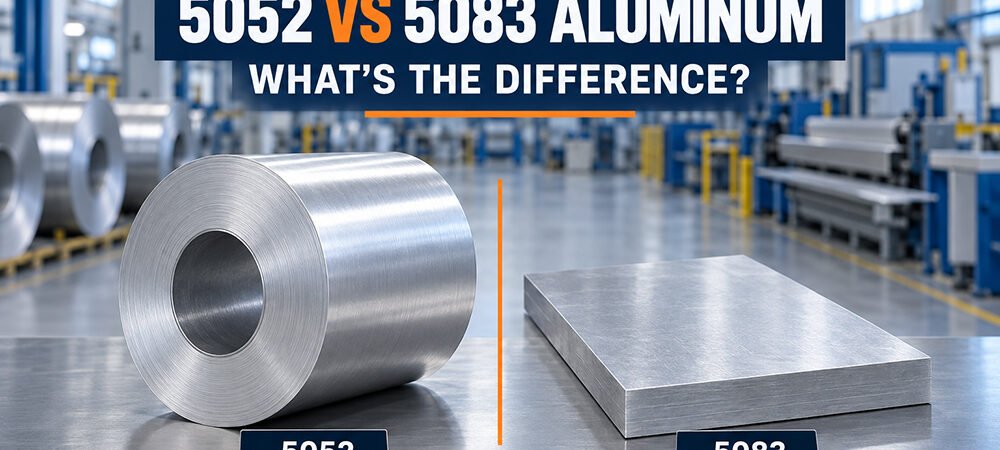
5052 vs 5083 Aluminum: What’s the Difference?
A practical comparison of strength, corrosion resistance, formability, weldability, applications and cost.
5052 vs 5083 Aluminum at a Glance
5052 and 5083 are both non-heat-treatable aluminum-magnesium alloys. Both offer good corrosion resistance and weldability, but they are designed for different applications.
In simple terms: 5052 is generally preferred for forming, bending and general sheet-metal work, while 5083 is selected for higher-strength welded structures and demanding marine applications.
| Comparison | 5052 Aluminum | 5083 Aluminum |
|---|---|---|
| Alloy family | Aluminum-magnesium | Aluminum-magnesium-manganese |
| Relative strength | Medium | Higher |
| Corrosion resistance | Excellent | Excellent, especially for marine service |
| Formability | Better for bending and forming | Good; harder tempers require more care |
| Weldability | Excellent | Excellent |
| Common tempers | O, H22, H24, H32, H34 | O, H111, H116, H321 |
| Typical products | Sheet, coil and strip | Plate, sheet and marine products |
Actual mechanical properties depend on temper, thickness, production standard and material condition.
What Is 5052 Aluminum?
5052 is an aluminum-magnesium alloy known for its balance of corrosion resistance, moderate strength and good formability. It is widely used for sheet-metal components that require bending, stamping or fabrication.
Common products include aluminum sheet, coil, strip and tread plate. Typical applications include electrical enclosures, fuel tanks, vehicle panels, appliance parts, signs, architectural components and general fabricated products.
What Is 5083 Aluminum?
5083 is an aluminum-magnesium alloy with additional alloying elements that provide greater strength. It is widely used when strong welded structures and excellent resistance to seawater or demanding industrial environments are required.
Typical applications include shipbuilding, boat hulls, offshore structures, pressure vessels, storage tanks, transportation equipment and heavy-duty welded components. For marine construction, tempers such as 5083-H116 and 5083-H321 are commonly specified.
1. Strength Difference
5083 generally provides higher tensile and yield strength than 5052 when comparable product forms and conditions are considered. It is therefore more suitable for structural parts and heavy-duty welded fabrication.
5052 offers lower strength but is sufficient for many enclosures, tanks, panels and general sheet-metal applications.
2. Formability and Bending
5052 generally offers better forming and bending performance, particularly for sheet-metal parts requiring tighter bends or more complex shapes.
5083 can also be formed, especially in softer tempers, but its higher strength may require greater forming force and a larger bend radius. Alloy and temper should always be evaluated together.
3. Corrosion Resistance
Both alloys provide excellent corrosion resistance. 5052 performs well in freshwater, general outdoor and industrial environments. 5083 is particularly recognized for seawater resistance and is widely used for ships, boats and offshore structures.
The correct 5083 temper and service conditions remain important. Material selection should follow the applicable engineering and inspection requirements.
4. Weldability
Both 5052 and 5083 have good weldability. 5052 is commonly welded for tanks, enclosures and general components. 5083 is widely used for structural welding because it retains useful strength after welding.
The welding method, filler alloy, thickness and final service environment should be confirmed before production.
5. Machining Performance
Neither alloy is primarily selected for high-speed machining. 5052 is relatively soft and may produce longer chips. 5083 is stronger and can machine better in some tempers, but it is mainly used for plate fabrication and welding.
For precision-machined parts, another alloy such as 6061 may sometimes be more suitable, depending on the complete requirements.
6. Product Form and Availability
5052 is commonly available as thin sheet, coil, narrow strip and tread plate. 5083 is commonly supplied as medium or thick plate, marine plate and structural sheet.
For thin coil or narrow strip, 5052 may be easier to source. For thick plate or high-strength welded structures, 5083 is generally the more suitable choice. Availability depends on temper, dimensions, tolerances and quantity.
7. Cost Difference
5083 is usually more expensive because of its higher alloy content, greater strength and more specialized applications. Purchasing price should not be the only consideration.
The most economical material is the alloy that meets the application requirements without creating performance risks or unnecessary over-specification.
Choose 5052 When You Need
- Better bending and forming performance
- Thin aluminum sheet, coil or strip
- Moderate strength
- Good general corrosion resistance
- Enclosures, tanks or formed panels
Choose 5083 When You Need
- Higher structural strength
- Marine-grade performance
- Structural welding
- Medium or thick aluminum plate
- Ships, pressure vessels or heavy transport parts
Can 5052 Replace 5083?
5052 should not automatically replace 5083. Although both belong to the aluminum-magnesium family, 5052 generally has lower strength and may not meet structural or marine requirements originally specified for 5083.
Before substitution, review the required strength, temper, thickness, welding requirements, forming method, corrosion environment, design standard and certification requirements.
Can 5083 Replace 5052?
5083 may provide more strength than required, but that does not make it an automatic replacement. It may cost more, require greater forming force and behave differently during bending. For thin formed parts, 5052 may remain more practical and economical.
Conclusion
5052 and 5083 are both corrosion-resistant, weldable aluminum-magnesium alloys, but they serve different purposes.
5052 is generally better for forming, bending and general sheet-metal applications. 5083 is generally better for high-strength welded structures, marine applications and heavy-duty plate fabrication.
Before ordering, confirm the alloy, temper, thickness, dimensions, tolerances, mechanical properties, application and required certification.
Need Help Choosing 5052 or 5083 Aluminum?
Send Hongyuan Aluminum your alloy, temper, dimensions, quantity, application and technical requirements. Our team can evaluate a suitable material and production option.
Hongyuan Aluminum
Aluminum Coil | Sheet | Plate | Strip | Foil
www.hongyuan-aluminum.com