Introduction
3003 and 5052 are two widely used aluminum alloys for industrial and commercial applications. Both offer good corrosion resistance and formability, but they differ significantly in strength, composition, processing performance and typical applications.
Choosing between 3003 and 5052 aluminum depends on your project requirements, including strength, forming, welding, corrosion resistance and cost.
In this guide, we compare 3003 vs 5052 aluminum to help you select the right material for your application.
What Is 3003 Aluminum?
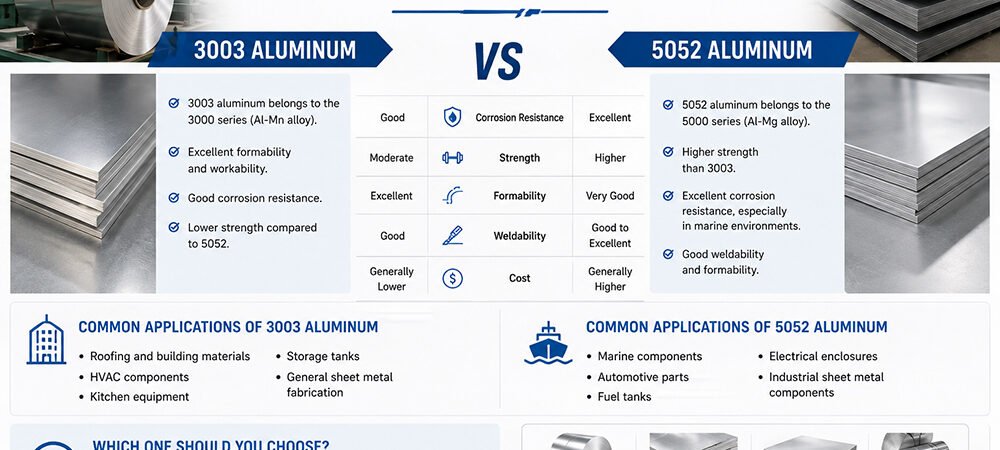
3003 aluminum belongs to the 3000 series aluminum-manganese alloys. It offers good corrosion resistance, excellent formability and reliable processing performance.
Because it is easy to bend, form and fabricate, 3003 aluminum is commonly used for applications that do not require very high mechanical strength.
Common Applications of 3003 Aluminum
Roofing and building materials
HVAC components
Insulation materials
Kitchen equipment
Storage tanks
Decorative products
General sheet metal fabrication
Common tempers include O, H14, H16, H18 and H24, depending on the required forming performance and strength.
What Is 5052 Aluminum?
5052 is a 5000 series aluminum-magnesium alloy. Compared with 3003, it provides significantly higher strength while maintaining excellent corrosion resistance, good formability and reliable weldability.
Its resistance to moisture and corrosive environments also makes 5052 suitable for more demanding industrial and transportation applications.
Common Applications of 5052 Aluminum
Marine components
Automotive parts
Transportation equipment
Fuel tanks
Electrical enclosures
Pressure vessels
Industrial sheet metal components
Common tempers include O, H32 and H34.
3003 vs 5052 Aluminum: Key Differences
Property 3003 Aluminum 5052 Aluminum
Alloy Series 3000 Series 5000 Series
Main Alloying Element Manganese Magnesium
Strength Moderate Higher
Corrosion Resistance Good Excellent
Formability Excellent Very Good
Weldability Good Excellent
Marine Applications Limited Better Choice
General Fabrication Excellent Excellent
Typical Cost Generally Lower Generally Higher
Which Is Stronger: 3003 or 5052 Aluminum?
5052 aluminum is generally stronger than 3003 aluminum.
This is one of the most important differences between the two alloys.
If your application requires greater mechanical strength, durability or resistance to demanding service conditions, 5052 is usually the better option.
However, higher strength is not always necessary.
For general forming, roofing, insulation and other applications where excellent workability is more important than high strength, 3003 can be a practical and economical choice.
Which Has Better Corrosion Resistance?
Both alloys provide good corrosion resistance, but 5052 generally performs better in more demanding environments, particularly where moisture or marine exposure is involved.
This is why 5052 is commonly selected for marine, transportation and outdoor industrial applications.
For normal indoor, construction and general-purpose applications, the corrosion resistance of 3003 is often sufficient.
Which Is Easier to Form?
3003 is known for its excellent formability and is particularly suitable for bending, deep drawing and forming operations.
5052 also offers good formability, but its higher strength means processing requirements can differ depending on the temper and thickness.
If complex forming is the main requirement and very high strength is unnecessary, 3003 may be the better choice.
3003 or 5052: Which Should You Choose?
Choose 3003 aluminum when your priority is:
Excellent formability
General corrosion resistance
Roofing or construction applications
HVAC and insulation
General sheet metal fabrication
Cost-effective material selection
Choose 5052 aluminum when your priority is:
Higher strength
Excellent corrosion resistance
Better performance in marine environments
Automotive or transportation applications
Fuel tanks and electrical enclosures
More demanding industrial fabrication